
TM.30 Form Thailand (ตม.30): PDF Download and Example
TM.30 (ตม.30) is the form that tells Thai Immigration where a foreigner is staying. The house owner, landlord or hotel must file it within 24 hours of a foreigner moving in, or coming back after a trip abroad.
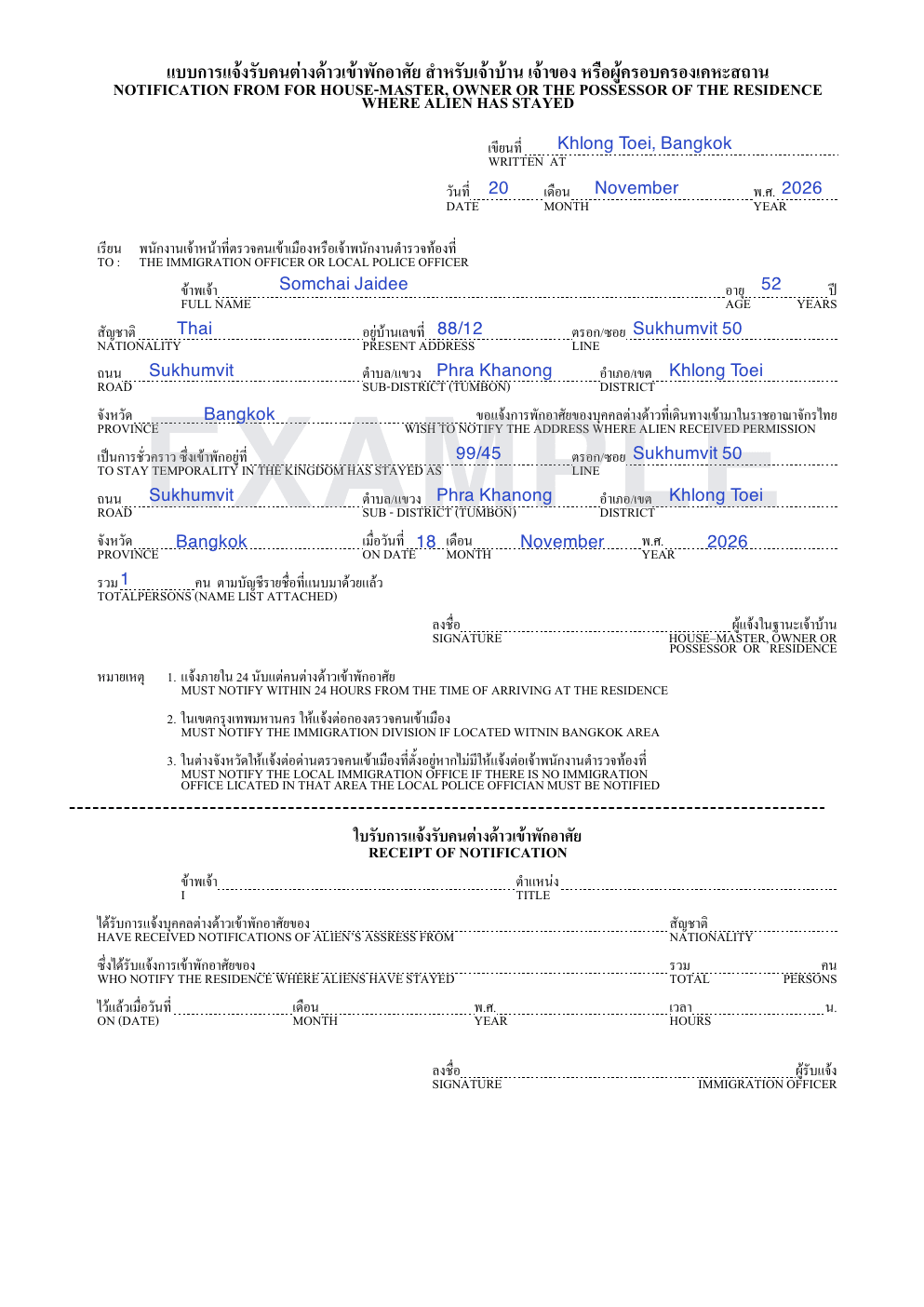
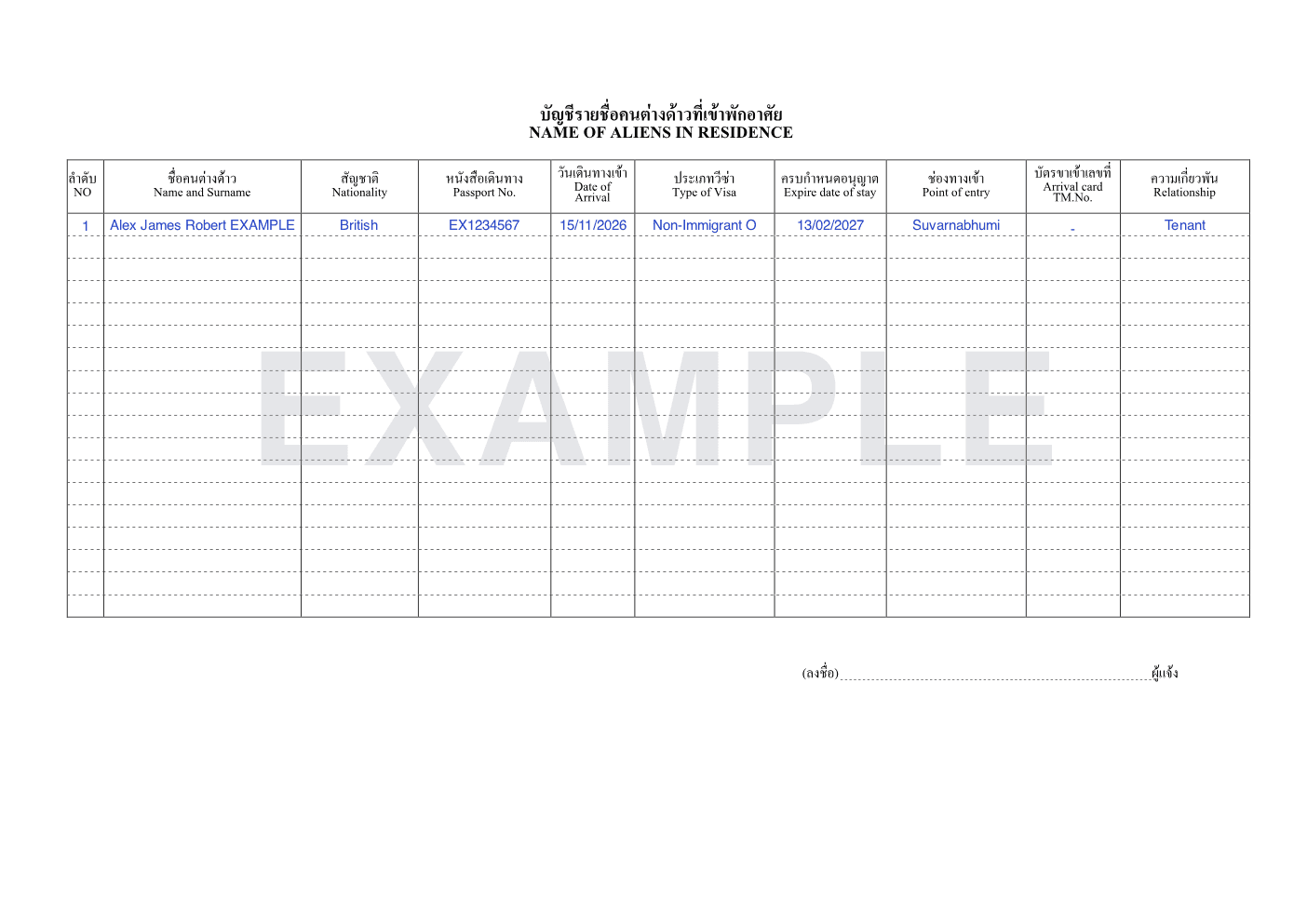
It has two pages. Page 1 is filled in by the owner: their details, the address where the foreigner is staying and the date they started staying there. Its bottom part is the Receipt of Notification, which the immigration officer stamps and gives back. Page 2 is a table listing each foreigner staying at the address, with their passport and visa details. There is no fee.
TM.30 can also be done online. The owner registers on the official immigration portal at tm30.immigration.go.th, adds each foreigner and downloads the record as proof, with no paper form and no trip to the office.
Filled TM.30 example
A fictional Thai condo owner reporting one foreign tenant who moved in on 18 November. The signatures and the officer’s receipt section are left blank.
Page 2: list of foreigners
How to fill in TM.30, field by field
Page 1: the owner and the address
- Written at
- Where the form is filled in, usually the district and province of the property, for example “Khlong Toei, Bangkok”.
- Date
- The date the form is filled in. The example uses the Western year (2026). The Thai label beside the year (พ.ศ.) means the Buddhist year, which is 543 years ahead (2569), so ask the office if you are unsure which it wants.
- Full name and age
- The house owner, landlord or person in charge of the property, not the foreigner. If you own your condo, this is you.
- Nationality and present address
- The owner’s nationality and their own address: house number, soi (“Line”), road, sub-district, district and province. For a Thai owner this is the address on their ID card.
- Address where the foreigner is staying
- The second address block, starting “to stay temporarily in the Kingdom has stayed at”. Write the address of the property the foreigner lives in. It can be the same as the owner’s address, for example when you live with your Thai spouse.
- On date
- The day the foreigner started staying there, or came back to it after travelling abroad. The form must reach immigration within 24 hours of this date.
- Total persons (name list attached)
- How many foreigners are staying there. This must match the number of people you list on page 2.
- Signature
- The house owner or person in charge signs here. If an agent or tenant hands it in for them, bring the owner’s signed authorisation letter.
- Receipt of Notification (bottom of page 1)
- Leave this blank. The immigration officer fills it in, stamps it and tears it off for you. This slip is your TM.30 receipt.
Page 2: one row for each foreigner
- Name and surname
- Exactly as in the passport, in capitals or neat handwriting. If the passport shows only one name, write just that.
- Nationality and passport no.
- From the passport photo page.
- Date of arrival
- The date the person last entered Thailand, from their entry stamp. This is often different from the “on date” on page 1, which is when they started staying at this address.
- Type of visa
- What the latest entry stamp or visa says, for example “Visa Exemption”, “Tourist Visa” or “Non-Immigrant O”.
- Expire date of stay
- The “admitted until” date on the latest entry stamp, or on the latest extension stamp if the person has extended.
- Point of entry
- The airport or border checkpoint on the entry stamp, for example Suvarnabhumi.
- Arrival card TM. No.
- Leave this blank or write a dash. It asks for the old paper TM.6 card number, and since the TM.6 was replaced by the online TDAC most people no longer have one. Ask the office if it wants something here.
- Relationship
- How the person is connected to the owner, for example “Tenant”, “Husband”, “Wife”, “Child” or “Guest”.
- Signature (page 2)
- The owner signs again under the table, on the line marked ผู้แจ้ง (notifier).
Where to hand in TM.30
- In person: at the immigration office that covers the property. Where there is no immigration office, the local police station.
- By post: registered post to that office, with copies of the documents and a stamped, self-addressed envelope for the receipt.
- Online: the owner registers on the official portal at tm30.immigration.go.th. Once an officer approves the account, the login is emailed to them. They then add each foreigner from their passport details, save, and download or print the record straight away, as there is no paper slip. No paper form is needed.
Bring or include the completed form, a copy of the owner’s ID card or passport and house registration, a copy of each foreigner’s passport photo page and latest entry stamp, and the rental contract if there is one. Offices vary, so check with yours first.
TM.30 questions
What is the TM.30 form?
TM.30 (ตม.30) is the Notification Form for House-Master, Owner or the Possessor of the Residence Where Alien Has Stayed. It tells Thai Immigration where a foreigner is living. It is not a visa form and does not change how long you can stay.
Who fills in the TM.30 form?
The house owner, landlord or person in charge of the property, not the foreigner staying there. Hotels file it for their guests. If you own your condo, you are the house owner and fill it in yourself.
When does TM.30 have to be filed?
Within 24 hours of a foreigner starting to stay at the property. That includes coming back to the same address after a trip abroad, so many people need a new TM.30 after every trip.
What goes on page 2 of TM.30?
Page 2 is the Name of Aliens in Residence: a table with one row for each foreigner staying at the address. Each row asks for the name, nationality, passport number, date of arrival in Thailand, type of visa, the date their stay expires, point of entry, arrival card number and their relationship to the owner. The owner signs underneath.
Do I need the paper form, or can TM.30 be filed online?
Yes, TM.30 can be done online. The owner registers on the official portal at tm30.immigration.go.th, and once the account is approved they add each foreigner and download the receipt. The paper PDF is for filing in person or by post, and for offices that still prefer paper.
Does it cost anything to file TM.30?
No. There is no fee to file TM.30 in person or online. By post you only pay the postage, including a stamped return envelope for your receipt.
Why do I need the TM.30 receipt?
Immigration often asks for it at extensions of stay, 90-day reports and Certificate of Residence applications. For a paper filing, keep the stamped slip from the bottom of page 1. For an online filing there is no paper slip, so download or print the record straight after saving it. Check your name and passport number are right.
For who is responsible in each situation, what the receipt shows and what happens if TM.30 isn’t filed, read the TM.30 guide.